Sciatica: why your leg is the problem, but your back is the cause.
Sciatica isn't a diagnosis — it's a symptom of something happening upstream. A plain-language guide to figuring out what.
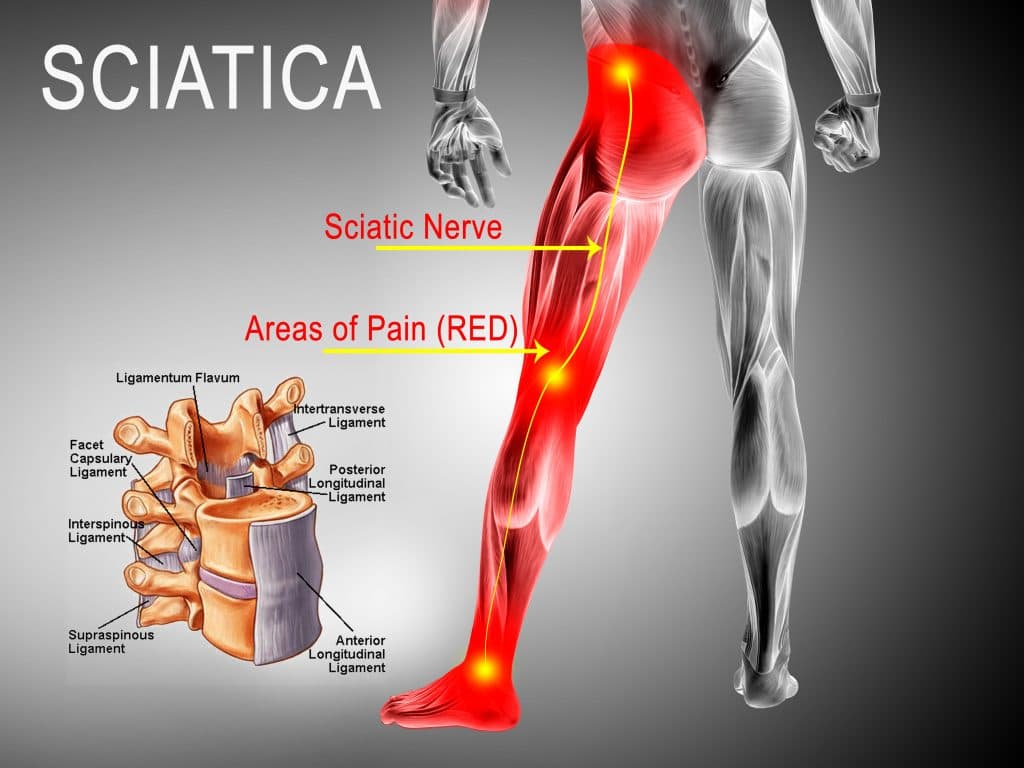
If you've been told you "have sciatica," what you actually have is a symptom — a sharp, electrical, sometimes burning pain that runs from the low back or buttock down the back or side of the leg. The sciatic nerve is the largest nerve in the body. When something pinches, compresses, or chemically irritates it anywhere along its path, the pain shows up downstream — in the leg.
This is why patients arrive convinced they have a leg problem. The leg is where it hurts. But the leg is almost never the cause.
The three most common upstream causes
Roughly nine out of ten sciatica cases come from one of three sources:
- Lumbar disc herniation. A disc between L4-L5 or L5-S1 bulges into the canal where the nerve root exits. This is the classic cause and the one most people picture.
- Facet joint and foraminal restriction. The bony channels the nerve passes through get narrowed by joint inflammation. Common in patients over 45.
- Piriformis or deep gluteal compression. The nerve passes near or through the piriformis muscle in the buttock. A tight or guarding piriformis can compress it. Harvard Health has good background reading on this.
The treatment changes radically depending on which of those three is driving the pain. Which is why the exam matters more than the imaging.
What good evaluation looks like
An MRI is occasionally necessary, but it's not where we start. The orthopedic and neurological exam tells us most of what we need to know in twenty minutes:
- Where the pain travels (dermatomal mapping)
- Which reflexes are blunted
- Which muscles have lost strength
- Which positions and movements provoke or relieve symptoms
For a thorough overview of the evaluation process from a medical perspective, the Mayo Clinic's sciatica page is plain-language and accurate.
What actually helps
For most disc-driven sciatica caught early, conservative care works. At The Spine Studio that usually means:
- Precision spinal adjustments to restore segmental motion above and below the involved level
- Soft-tissue work on the piriformis and lumbar paraspinals — these are almost always part of the picture
- Neural mobilization (nerve flossing) — gentle gliding of the nerve through its sheath
- A position-specific home plan — typically a series of extension-based movements (McKenzie protocol) for disc-driven cases
Most patients see meaningful change in 2–4 weeks. The studies Runner's World has covered on conservative care for athletes mirror what we see clinically: people who actually do the work get better; people who only chase passive treatments stall out.
Sudden numbness in the saddle area (between your legs), loss of bowel or bladder control, or progressive weakness in both legs is a medical emergency called cauda equina syndrome. Don't book a chiro visit — go to the ER. These signs are rare but they're surgical.
What patients ask me most
"Will it come back?" Possibly, if the underlying conditions don't change. Sciatica caused by years of poor sitting posture and weak glutes responds to treatment but recurs when the desk job resumes. Long-term, the goal is to make your spine resilient enough that the original load doesn't re-aggravate it.
"Can I keep training?" Almost always yes, with modifications. We work around it.
"How long is this going to take?" For acute, uncomplicated sciatica: a few weeks. For chronic cases with three or four episodes already on the books: months, but with a clear arc of improvement.
Get a proper sciatica evaluation.