Clinical acupuncture: the nervous-system recovery track most people skip.
Done everything for chronic tension and still feel wound up? The missing piece might be your nervous system — and a Licensed Acupuncturist on staff.
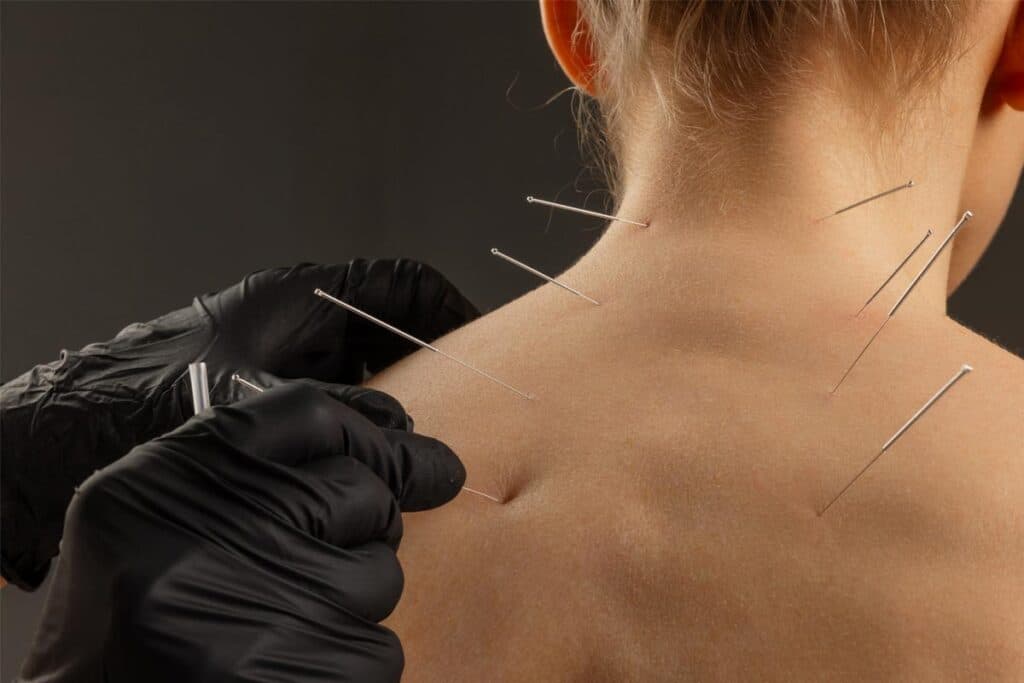
When most people hear "acupuncture," they picture relaxation — a quiet room, soft music, needles left in for twenty minutes while you doze off. Clinical acupuncture, as practiced by a Licensed Acupuncturist (L.Ac), is a different animal entirely. It's a targeted neurological intervention, grounded in an understanding of how the nervous system processes pain, regulates inflammation, and controls muscle tone — and it's one of the most underused tools for patients who feel "wound up" everywhere and can't figure out why nothing relaxes.
Dr. Andersen holds dual credentials as a Doctor of Chiropractic and a Licensed Acupuncturist (L.Ac) — a combination that's relatively rare. It means the acupuncture you receive at The Spine Studio isn't an add-on service performed by a separate practitioner with a separate intake. It's integrated into the same clinical reasoning that drives your adjustment, your dry needling, and your rehab plan — chosen specifically because your nervous system, not just your joints, is part of the problem.
How clinical acupuncture actually works
Set aside the historical framework for a moment and look at what's been measured in modern research, including findings summarized by the National Center for Complementary and Integrative Health (NCCIH), part of the NIH. Fine needles placed at specific points — often along nerve pathways, near peripheral nerves, or at well-mapped trigger sites — create a controlled sensory input that the nervous system has to respond to. That response cascades through three systems that matter enormously for chronic pain:
- The pain-gating system. Acupuncture stimulates A-delta nerve fibers, which trigger the spinal cord and brainstem to release endogenous opioids and other neurotransmitters that "close the gate" on incoming pain signals from elsewhere in the body. This is part of why a needle placed in the hand or foot can measurably reduce pain in the low back or neck — the input and the output don't have to be at the same location.
- The autonomic nervous system. Many chronic pain patients are stuck in a low-grade sympathetic ("fight or flight") state — elevated muscle tone, shallow breathing, poor sleep, and a nervous system that interprets normal movement as threatening. Acupuncture has a measurable parasympathetic effect, shifting the body toward the "rest and repair" state where actual tissue healing and muscle relaxation can occur.
- Local and systemic inflammation. Needling triggers local microcirculation changes and influences the release of anti-inflammatory mediators. For patients dealing with diffuse, low-grade inflammatory pain — the kind that doesn't show up clearly on imaging but shows up everywhere in the body — this systemic effect is often more clinically relevant than any single localized change.
Dry needling and acupuncture can look similar from the outside — both use thin needles. But they're answering different questions. Dry needling asks, "what's the tight, angry muscle doing right now?" Clinical acupuncture asks, "why is your nervous system running hot everywhere, and how do we turn that down?"
Down-regulating hyperactive muscle guarding
One of the most common patterns we see is a patient whose muscles are protectively "guarding" — staying chronically tight not because of a structural problem in that specific muscle, but because the nervous system has decided that area needs to be braced. You can stretch it, foam-roll it, and get a massage on it, and it tightens right back up within a day or two, because the input causing the guarding hasn't changed.
Clinical acupuncture works on this pattern from the top down. By calming the central drivers of that guarding response — the parts of the nervous system that decided bracing was necessary in the first place — muscles that have been "stuck" for months can finally hold a looser resting tone after manual work, rather than snapping back within hours. This is often the missing piece for patients who've done "everything" for a chronically tight neck, jaw, or low back and still wake up feeling braced.
What clinical acupuncture is used for
- Chronic, diffuse pain patterns that don't map neatly to a single joint or muscle — widespread tension, fibromyalgia-type presentations, and pain that "moves around."
- Tension-type and cervicogenic headaches, particularly when they're driven by a hyperactive nervous system rather than a single mechanical trigger.
- Sleep disruption tied to pain — when pain and poor sleep have become a feedback loop, calming the autonomic nervous system can interrupt the cycle from both directions.
- Stress-related muscle tension — jaw clenching, shoulder elevation, and breath-holding patterns that show up as physical pain but are driven by nervous system arousal.
- Post-injury recovery plateaus — cases where the tissue itself has healed but the nervous system hasn't "gotten the memo," and pain or guarding persists out of proportion to the original injury.
- Complementary support for chronic conditions such as long-standing sciatica, migraine, and post-surgical recovery, where systemic inflammation and nervous system sensitization are part of the picture.
What a session looks like
Sessions typically run 30–45 minutes. After a focused intake on your pain pattern, sleep, stress load, and nervous system symptoms, fine needles are placed at a combination of local and distal points and left in place while you rest — most patients describe the sensation as a dull, heavy warmth rather than sharp pain. Many people notice a shift in how their breathing and muscle tone feel within the first session, though the cumulative, longer-lasting changes build over a short course of visits.
The investment: an independent recovery track
Because clinical acupuncture addresses the nervous system as a whole — rather than a single joint or muscle — it operates as its own dedicated track, separate from standard spinal adjustment and follow-up visit pricing. Clinical acupuncture is priced at $80 per session. Some patients use it as a standalone series for nervous-system-driven pain patterns; others layer it into an existing care plan alongside adjustments, dry needling, or rehab work when the picture calls for both a structural and a neurological approach.
We frame it the way the physiology supports framing it: as elite-level recovery infrastructure for a nervous system that's been running hot for too long — not a relaxation add-on, but a clinical tool aimed at the system that's been quietly keeping your pain switched on.
Is it right for you?
If you've addressed the obvious structural issues — your joints move better, your muscles have been worked on, your exercises are dialed in — and you're still waking up tight, still getting headaches, still feeling like your body never fully powers down, your nervous system may be the part of the equation that hasn't been addressed yet. That's exactly the gap clinical acupuncture is built to close.
Book an assessment to see if clinical acupuncture belongs in your plan.